The Pottery
<< Back
to Virtural Tour


In the spring of 1848 a group of hopeful English settlers boarded the ship “Gypsy Queen” in Liverpool, England
bound for land grant properties in north Texas. This group included John
Jackson and his family, Lionel Simpson, Joseph Hildreth, and Thomas Sims. They
were to form the foundation of what would become known as ‘the English Colony’
in northern Dallas County, all claming Peter’s Colony land grants in the
Farmer’s Branch area.
Thomas Sims arrived alone to claim his land, near the elm Fork of the Trinity
River, with the intention of sending back to England for his family after
getting settled. After staking his land claim and constructing a log home,
Thomas Sims became seriously ill and died in mid-1849, before his family had
even left England. In the summer of 1850 his eldest son, Edward, arrived in
Dallas County with his widowed mother Mary and claimed his father’s land.
During the next five years Edward Sims invested much of his available capital
in building a large new farmhouse and out buildings on the property. By 1857 it
had become obvious that the land selected by Thomas Sims as the family
homestead was no well suited for agricultural use as it sat too near the river
and had shallow soil over a limestone base. The Sims, who had exhausted their
money building a fine home, found it increasingly difficult to afford paid
agricultural labor and their English Presbyterian morals did not condone
slavery. Thomas Sims began to write letters trying to convince his younger
brother, John, to immigrate from Staffordshire where he had been serving an
apprenticeship as a potter.
John Sims, 23 years old, arrived in Dallas County in April of 1860. Faced with
the unprofitable agricultural work for which he was ill suited John soon
located a clay bank along the family’s river property and set up a small
pottery shop in a carriage house behind their home. A groundhog kiln was
constructed and soon he began producing household ceramic for family use and
the local market.
Political tensions in the county grew at a fevered rate following the July 1860
fire, blamed on a feared slave uprising, which destroyed most of the city of
Dallas. By early 1861 most of the county was caught up in the discussion over
secession and state’s rights. When Texas secession occurred, in early march
1861, and the call for troops went out many non-native residents like the Sims
family found themselves in a conflicted position. Some, like Edward Sims, had a
strong bias against secession as they were only newly United States citizens.
Others, as relative newcomers to this country, did not feel that this was
really their fight from either viewpoint. While Dallas County voted for
secession, Denton and Collin Counties voted against the proposition. The Sims
family found its property in the midst of a political powder keg.
When President Lincoln made his first call for troops in April 1861 Edward Sims
headed toward the northern states with the intention of joining a Union unit.
Since his departure his family in Dallas County has heard no news from him and
his whereabouts is not known.
After the departure of his older brother a lack of funds or labor to operate
the Sims property as a viable farm caused John Sims and his mother to turn
almost completely to their small pottery business to support themselves. Mrs.
Sims began selling an assortment of items to the community out of her home. Jon
Sims unwillingness to take up either side of the Secession issue has left both
Confederate and Union factions in the county suspicious of the family. With
their livelihood uncertain 1861 is a very unsettled year for the Sims family.
The move from an urban setting in the English midlands to the rural setting of
the Texas frontier has proved less than satisfactory for John Sims. His
disappointment in the family farm, his brother’s defection to join the Union
Army, and his neighbor’s less than friendly attitude towards his apolitical
approach to Secession have left him a little bitter about where life has led
him. Working with clay seems to provide his only real satisfaction.
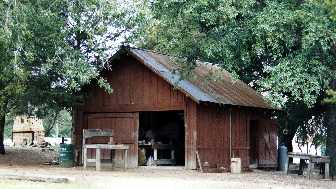 This small barn was built at the
rear of a residential lot in Gainesville, Texas, and used to house a horse and
carriage. Today, it is the work place for Dallas Heritage Village's resident
potter, who demonstrates late 19th-century methods of pottery making. Typically
potters erected simple wooden sheds near good sources of clay, water, and
firewood. This small barn was built at the
rear of a residential lot in Gainesville, Texas, and used to house a horse and
carriage. Today, it is the work place for Dallas Heritage Village's resident
potter, who demonstrates late 19th-century methods of pottery making. Typically
potters erected simple wooden sheds near good sources of clay, water, and
firewood.
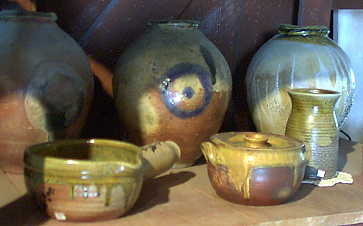
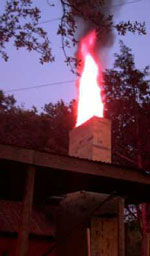
The firing of the groundhog kiln is quite a sight to see. The fire must be
constantly tended for 24 hours and when the kiln is up to temperature flames
shoot out the chimney!
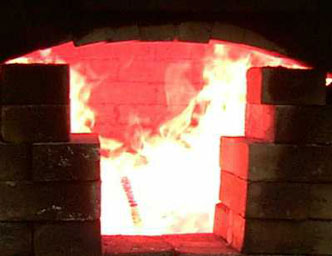 
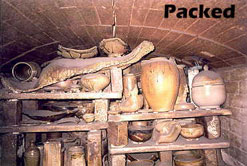
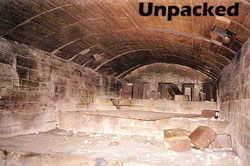
The kiln is packed very carefully to maximize content.
|