

During fall and spring Living History Seasons, special exhibits and characters dressed in period clothing
bring to life important historical themes. Now through June 30, 2009 delight in
No Hand Idle: Domestic Arts of the 19th Century. In fall 2009, discover how truly "green"
Dallas' earliest residents really were during Green Fields, Black Smoke: Nature and Progress When Dallas was Young
(October-December 2009 & March-June 2010).
During Summer and Winter Seasons, the museum's 38 historic structures will be open for self-guided or private,
docent-led tours. The Village's historic costumed characters will not found be on the grounds February or July.
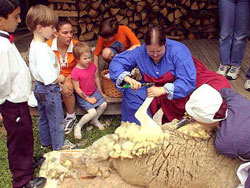 Living history changes the presentation of materials and information from a typical
“static” exhibit that a visitor would view from a distance (think roped-off paintings at an art museum, or artifacts displayed
in a glass exhibit case) to a live experience, where the visitor talks with a costumed character of the past who is speaking
in the vernacular of the day. Often the visitor interacts not only with the interpreter but also his/her surroundings. For
example, a visitor to the Farmstead at Dallas Heritage Village will be greeted by “Mrs. Kennedy.” You can sit in her parlor,
play checkers, help her with chores and talk with her about the current "Living History" theme, her gardens, animals, etc.
Living history tends to be multi-sensory, providing sights, sounds, smells and textures.
Living history changes the presentation of materials and information from a typical
“static” exhibit that a visitor would view from a distance (think roped-off paintings at an art museum, or artifacts displayed
in a glass exhibit case) to a live experience, where the visitor talks with a costumed character of the past who is speaking
in the vernacular of the day. Often the visitor interacts not only with the interpreter but also his/her surroundings. For
example, a visitor to the Farmstead at Dallas Heritage Village will be greeted by “Mrs. Kennedy.” You can sit in her parlor,
play checkers, help her with chores and talk with her about the current "Living History" theme, her gardens, animals, etc.
Living history tends to be multi-sensory, providing sights, sounds, smells and textures.
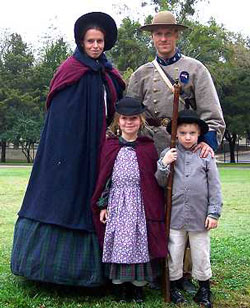 The costumed
interpreters you will encounter portray fictional characters based
on the social demographics of North Texas during a specific year falling within the mid-nineteenth to the early twentieth centuries.
These composite characters are developed to represent the complex social, political, ethnic, and religious backgrounds of
many of the area’s residents.
The costumed
interpreters you will encounter portray fictional characters based
on the social demographics of North Texas during a specific year falling within the mid-nineteenth to the early twentieth centuries.
These composite characters are developed to represent the complex social, political, ethnic, and religious backgrounds of
many of the area’s residents.
Remember that for the First Person Interpreters,
it is always today’s day and month, but always their year in the past. They have no knowledge of anything
more recent than their year. Careful questioning can help you learn about our history and daily life in the past!
Learn more about some of our living history areas.
The 1860s Living Farmstead
The Clementine Freight & Delivery Service
1901 Blum Household, Traditional Judaism in the Early 20th Century