Farm Livestock
1860s Living
Farmstead | About the
Farm | Livestock | The Year is 1861


Our flock is currently composed of 6 adult Rambouillet ewes. (Rambouilett is
pronounced ram-boo-'lay.) The newest members of the flock, Dora and Maude, were
donated by the national secretaries of the American Rambouillet Sheep Breeders Association, Burk and Bernadette Lattimore of Levelland, Texas.
Rambouillets are a large hardy sheep that have been breed to
thrive in our Western climate. Rambouillets have played a large role in the
sheep industry in Texas since its inception and still do today. The American Rambouillet Sheep Breeders Association is located in Texas.
Rambouillets are primarily wool sheep producing a heavy fine wool fleece. The
breed was developed from Spanish Merinos and French stock in the late 1700s.
While researching historic sheep breeds for our new flock we found a notice from
the July 31, 1858 Dallas Herald stating that a herd of French Merinos,
another term for Rambouillets; had just been brought into the Dallas area.
The Dallas Herald July 31, 1858
"Dr. Scott of this county, has a drove of 1800 select blooded ewes in route
from Missouri and Illinois. Sheep breeding is proving to be a most remunerative
business. Texas is peculiarly and happily adapted to it…. For sale by Roy
Scott – 1800 select ewes, 300 pure French Merinos,
mixed Cotswold,
Southdown, Merino and Yorkshires."
Full grown the ewes can weigh from 150 – 175 lbs.
Their fleeces can weigh from 8 –18 lbs with 35 – 55% yield. That is how much
wool is produced after the fleece is washed and carded. The Kennedy family will
be well supplied with wool.
Lucy is a 4-year old roan Durham. Durham is the older breed
term for Milking Shorthorns. Durhams are one of the oldest recognized breeds in
the world. The breed developed in England in the 1600's. The first Durhams
were imported into the United States in 1783 and had spread west of the
Mississippi by 1839.
Wm. H. Jones placed an ad in the January 4, 1860 Dallas
Herald - "I have for sale seven head of thorough-bred Durham Cattle, that
have been in this State since last winter, and thoroughly acclimated, and in
fine condition, which will be sold at reasonable prices."
Durham's are on the American Livestock Breed Conservancy "watched breed" list. That means that "fewer than 2,500 annual
North American registrations and estimated fewer than 10,000 global population.
(Also included are dairy cattle breeds which show marked decline in numbers over
the last 20 years.)"
Did you know cows produced 13 gallons of saliva a day? They
need that much to help break down the plant fibers they eat.
Our chicken yard is full of Dominique hens. Dominiques are the
oldest poultry breed developed in the United States. Dominiques are on
the American Livestock Breed Conservancy "Critically Rare" list. That means there are "Fewer than 500
breeding birds in North America, with five or fewer primary breeding flocks."
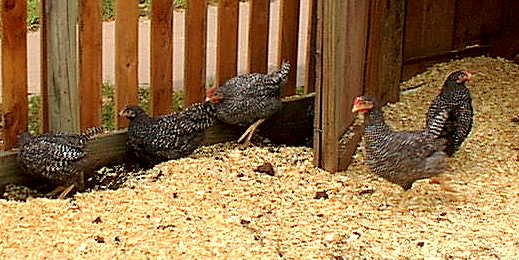
Read more about Dominiques at the Oklahoma Breeds
of Livestock Web Site.
|