|
All Aboard! This special school tour is designed to introduce students to the history of the North Texas area following the coming of the railroads. It is geared for students from fifth through eighth grades. Statement of Purpose | TEKS | Objectives | Buildings on Tour | Before your tour | After your tour | Other important information The purpose of the "All Aboard!" tour is to provide an awareness of what life was like in North Central Texas during the years from 1872 � 1910, after the coming of the railroads. This discovery will be made through the interpretation of selected structures and material objects at Old City Park. TEKS, Texas Essential Knowledge and Skills for Social Studies Covered in the Tour Grade 5
Grade 6
Grade 7
Shotgun House , Section House, Print Shop, General Store, George House
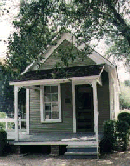
This house was built on Guillot Street in the State-Thomas neighborhood in Dallas. It is a typical shotgun house, which is defined as "a house that is one room wide and at least two rooms deep." The name of this style of house may be derived from an African word "to-gun" meaning a place of assembly. Folk etymology, however, attributes the name to the fact that you could shoot a shotgun straight through the house because of its arrangement. Houses of this type can be constructed cheaply and easily, and were often used for rental housing. This particular house was built by a doctor as rental property, and was occupied by a working-class African-American family. Because the house is so small, the rooms served multiple purposes; the front sitting room also contains a child�s bed, and the dining table is in the kitchen.
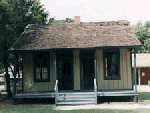
Old City Park's Section House was built in the 1880s in Carrollton, Texas. Like many Texas homes of the period, it was a very simple dwelling. There are only two rooms: one for sleeping, and the other for all other household activities. The house had no electricity, running water, or plumbing. All water had to be hauled in from a well or cistern outside and heated over the wood-burning cast iron stove. The occupants of the Section House would have conserved their kerosene and water, using one tub of water for dishes, bathing, and finally cleaning the floor. The Section House was owned by the railroad companies and was often occupied by the men that they hired to take care of a section of the track. However, if the section foreman was married, his family would occupy the house, and the crew would sleep in a boxcar or bunkhouse nearby. The section may have extended from five to fifteen miles long, depending on the region. A section foreman would be in charge of a gang of four to eight men whose job was to keep the track in good repair by replacing wooden ties, pruning vegetation away from the tracks, and checking the trestles over creeks and gullies. Because all the buildings owned by a railroad would have been painted in that railroad's colors, the Section House at Old City Park has the same colors as the MKT Depot. The house served as a home to the crew, usually all men. The salary for a section foreman or manager was considered good in those days - $2.40 per day! While it was a bonus to be paid well and have housing provided, the job of maintaining the railroad track was tedious and often lonely.
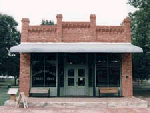
Printing is a vital industry to society. By the end of the nineteenth century, technology had produced faster, more efficient printing presses, less expensive paper, and mechanical typesetting machines. The expansion of the railroads and the development of the telegraph system allowed quick communication between correspondents across the nation. The reduction of newspaper postage and the creation of Rural Free Delivery opened up entirely new markets for published works. The print shop became an important business in most towns. It was here that merchants obtained business cards, invoices, order forms, and other materials necessary to operate their businesses. If the printer produced a newspaper, merchants had a place to advertise their services to the community and townspeople often stopped by to find out what was going on. The building which housed the Print Shop was constructed in 1906, in Savoy, Texas, and is typical of small town, commercial architecture at the turn of the century. As a town grew and prospered, the first wooden buildings were replaced with more impressive, durable structures made of stone or locally manufactured brick. Print shops came to be regarded as a symbol of a town�s progress.
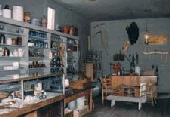
General Store: 1907 In the nineteenth century, the General Store was an institution throughout the United States that moved west as the frontier expanded. The General Store carried everything from fresh produce to canned goods, clothing to patent medicines, and seeds to farm implements. Since everyone used the General Store, it was often the center for community activities. In many cases it was also the local post office, with the storekeeper serving as the postmaster. Because the storekeeper extended credit to farmers until their crops were harvested, he also played a vital economic role in the community. Before the railroads, storekeepers made trips to eastern marketing centers once or twice a year to order supplies and have them shipped to Dallas from Houston, Shreveport, and Jefferson by long trains of ox-drawn wagons. With the arrival of the railroad, wholesale suppliers were able to send commercial salesmen to these small community stores. By the turn of the century, nearly all wholesale ordering was done through these traveling salesmen or "drummers." Always a busy place, the General Store, with its distinctive smells and warm stove, attracted many "regulars" who would come to hear the latest gossip or play checkers on the porch. Old City Park's General Store was built in 1907 on Wolf Street in Dallas.
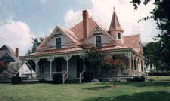
The George House was built in Plano in 1900 by David C. George, a local hardware merchant, as a wedding present for his bride. The house is a typical middle-class version of the Queen Anne style architecture which was popular throughout the United States between 1880 and 1910. Queen Anne homes were characterized by picturesque exteriors with bay windows, turrets, and wrap-around porches decorated with jigsaw trim. Inside, the rooms are oddly shaped with high ceilings, transom windows over the doors for ventilation, and colorful wallpaper on the walls and ceilings. The shift of the American population from the farm to the town was well underway by 1900. The political, economic, and social life of the country was beginning to be dominated by the middle classes, people who entered the professions, started businesses, and offered new services. The George House depicts the tastes, styles, manners, and customs of the growing middle class. Agriculture was still the major industry in Collin County; even in the towns, many residents grew fruit and vegetables in their gardens and kept chickens or a cow. Because Plano was located on the railroad line and only eighteen miles north of downtown Dallas, the George House could boast of such modern conveniences as early electric wiring, a woodburning cookstove, an ice box, linoleum flooring in the kitchen, and a metal shingle roof. After 1872, wallpaper was another novelty associated with industrialism. The train was able to bring in a new level of comfort with manufactured goods from the east coast and from the factories.
You may take self-guided tours of these buildings:
To see other buildings not included in this list or on your tour, students and teachers are invited to return for a weekend visit or another school tour, such as our Candlelight or African-American Heritage Tours.
There is a soda machine between the General Store and McCall�s Store. ALL ABOARD! Follow-up Questions |
|
| Third Saturday Series | 1860's Farm | Rentals | Membership | Museum Store | Brent Place Restaurant| | Employment & Volunteer Opportunties | Contact Us | Local Links | What's New | Museum History| |
|
|