
|
Living on the Prairie Come live on the Prairie for a little while� learn to make pinch pots from the Potter, and how to cook over an open fire! This special school tour is designed to teach younger students about frontier life. It is geared toward pre-kindergarten through second grade. Statement of Purpose | TEKS | Objectives | Buildings on Tour | Before your tour | After your tour | Other important information The purpose of the tour "Living on the Prairie" is to provide younger students with an awareness of what life was like in North Central Texas between 1840 and 1910. This awareness will come through visits with the Old City Park craftspeople, interaction with material objects, and hands-on activities. TEKS - Texas Essential Knowledge and Skills for Social Studies Covered in the TourGrade K
Grade 1
Grade 2
Buildings on Tour: Potter�s Shed, Print Shop, 1860�s Living Farmstead
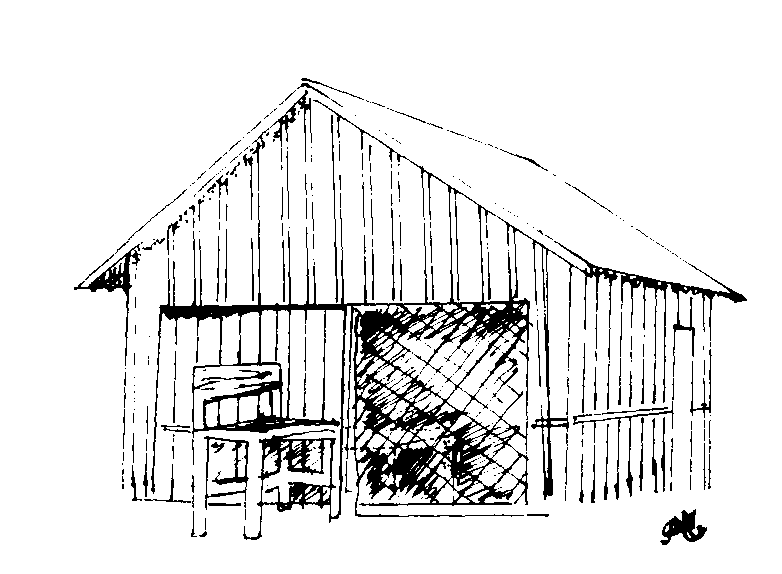
Pottery Shed (1893) Pottery has been made in Texas for centuries. With the obvious abundance of clay, Native Americans were encouraged to create earthenware vessels. Later, in the 16th century, the arrival of the Spaniards brought with it the more sophisticated technique of wheel-made or "thrown" pottery. The pioneer potter�s primary need was to be near good clay, water, and firewood; and as good clay is usually found in areas also suitable for agriculture, pioneer potters would farm as a profession and make pots on a part-time basis. However, as the population of a community increased, so did the demand for storage and cooking containers and the potter was able to devote more time to his trade. By the mid 1800s, there were twelve pottery plants operating in Texas. Before firing, pots are laid out to dry; at this stage, they are very fragile and not useable as they are still water soluble. It is the extreme heat of the firing process that gives them strength. The groundhog kiln at Old City Park is a replica of the kilns used by early Texas potters. When the potter has enough pieces for a full load, he crawls into the kiln and places the pots into the firing chamber. After he crawls back out, he starts a wood fire in the firebox. A wood-fired kiln takes from twelve to twenty-four hours of stoking to reach a maximum temperature of 1260 C, or 2268 F. During the last few hours of firing, known as "blast off," fuel is added as quickly as it is consumed in an effort to keep the heat rising. After the manual firing is completed, the firebox door is closed, all spy hole bricks are replaced, and the low chimney is covered with a piece of metal. Two to three days may pass before the kiln can be opened; not only are the pots too hot to touch, but too-rapid cooling will cause a contraction of the clay and the pots will crack. Texas potters generally fired their wares once a month. The loss of a load was critical as it meant the loss of income for the entire period of throwing, glazing, drying, and firing. Activity Pinch Pots Each child will be given a small clump of clay to pinch into a pot or other form. The children will be allowed to take their creations home with them!
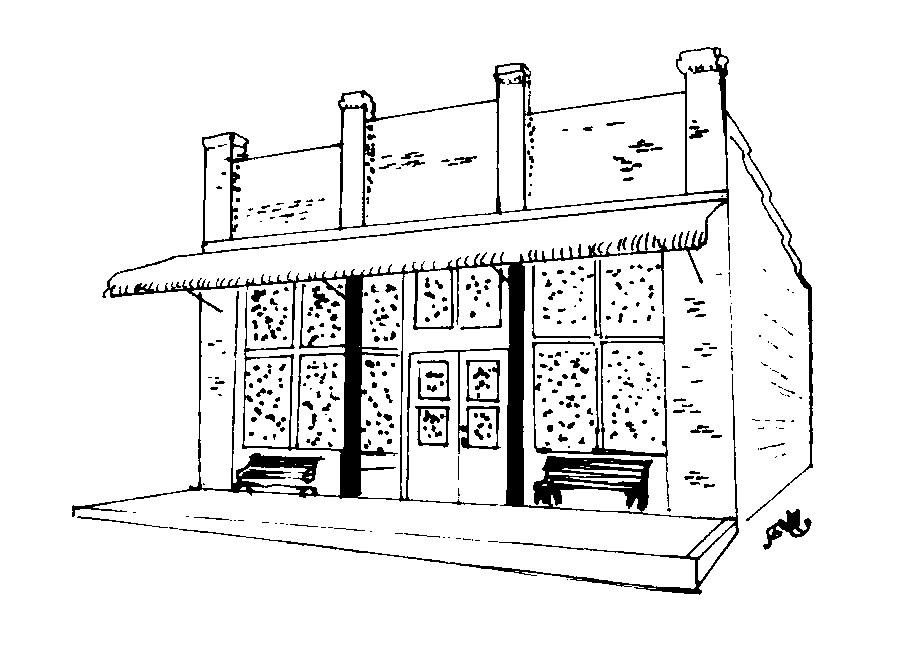
Print Shop (1906) Printing is a vital industry to society. Without it, education and communication would be severely limited. By the end of the nineteenth century, technology had produced faster, more efficient printing presses, less expensive paper, and mechanical typesetting machines. The expansion of the railroads and the development of the telegraph system allowed quick communication between correspondents across the nation. The reduction of newspaper postage and the creation of Rural Free Delivery opened up entirely new markets for published works. The print shop became an important business in most towns. It was here that merchants obtained business cards, invoices, order forms, and other materials necessary to operate their businesses. If the printer produced a newspaper, merchants had a place to advertise their services to the community. Since the print shop was a center for the collection of news, townspeople often stopped by to find out what was going on. The building that houses the Print Shop was constructed in 1906 in Savoy, Texas, and is typical of small town, commercial architecture at the turn of the century. As a town grew and prospered, the first wooden store buildings were replaced with more impressive, durable structures made of stone or locally manufactured brick. Cast iron fronts were popular because they were strong and relatively fire proof, could be cast in a variety of ornamental forms, and could be shipped cheaply by rail. They came to be regarded as a symbol of progress. Activity Printing Students will get to print a bookmark or card using an actual 1880�s press with type which was hand-set by our Printer! This small press, called a "proofing" press, was often used to check the typesetting on documents before they were printed in large numbers on a mechanized press.
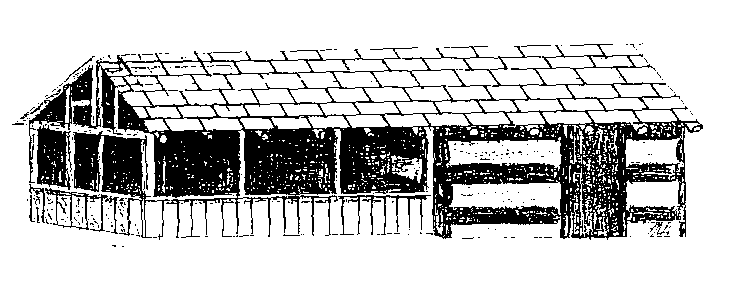
The pioneers who settled in the North Central Texas region had to be "Jacks (or Janes) of all Trades"� they had to perform a wide variety of tasks in order to provide the necessities of life for themselves and their families. Several of these things are illustrated in the 1860�s Living Farmstead. Your group will visit with costumed interpreters, who will teach you about whatever they happen to be doing at the time, whether it is animal care, household work, blacksmithing, gardening, or cooking. Animals: Animal husbandry is a skill which was essential to the pioneers. Old City Park has several animals which are typical of farm animals from this time period: Jersey cattle were kept primarily for milk. The cow�s odd-looking bony hips are a result of breeding, as is her heavy udder. Jersey cows give very rich milk, an important source of dietary fat and protein on the frontier, as well as the basis for butter, cheese, and many other processed foods. Sheep are kept for both wool and meat use. The black-faced Suffolks and the white-faced Cheviots are both varieties which were brought into North Central Texas fairly early on. These are dual purpose animals, meaning that they produced good meat and good wool; some varieties were specialized for one use or the other. Chickens are another dual purpose animal; they are used both for eggs and for food. There are a variety of different chickens in the yard, including Buff Orphingtons, which look like classic "Little Red Hen" hens, Cochins, which are red with feathered feet, and Plymouth Barred Rocks, which are gray and white. Household Tasks: A wide variety of different activities, from making butter and cooking to cleaning and laundry fall under what was formerly called "housewifery." These tasks all contribute to the function of the household. Blacksmithing: The shed across from the kitchen is used as a workshop for a variety of tool making and repair needs. The forge is used to heat iron to red-hot temperatures, and then the anvil and hammer are used to shape it as needed. Most good-sized farms would have had such a shop, although it would only be used as needed. Gardening: Raising vegetables for food is another skill which all pioneers needed. The vegetables in the kitchen garden were used to provide the main portion of most meals, and many were preserved for food during the winter months. 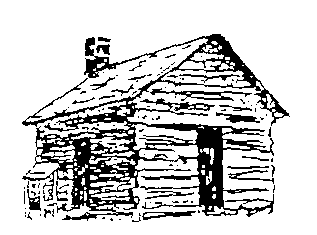 Cooking Detached log kitchens allowed early settlers to separate the smells, smoke, and heat of cooking, as well as the danger of fire, from their living quarters. Utilitarian in design, they often had dirt floors, exposed rafters, and a single window. In many instances, the first cabins, which had been hastily built as shelter by newly arrived families, were later converted to kitchens after larger, more finished log houses could be built for the family dwelling. The fireplace included a wide hearth to allow room for cooking on a bed of coals. Hot coals would be raked out onto the hearth, and Dutch ovens, gridirons, and long-legged skillets called spiders would be set on top of the coals to bake or fry foods. A pivoting iron arm, known as a crane, was installed on one inside wall of the fireplace. It provided a means of suspending utensils over the fire, while allowing the cook to control temperature and time by swinging the crane away from the fire. Activities (One activity will be available each day)
Once harvested, corn has to be processed. Today, large mechanical combines process corn in the fields but in the late 1800s, it was time-consuming hand labor. The first step was to shuck the corn to remove its husk. Then the kernels had to be stripped from the ear. Often this was done by hand � by a strong thumb or a scrapper rigged by the individual to fit his hand. We will use a corn sheller, a "modern" convenience for the 1860�s!
Butter is made from the cream which rises to the top of milk. It is used for a variety of food and cooking uses; It is an important ingredient for many dishes. Butter is made in a churn, which is a container made of wood or ceramic with a dasher that agitates the cream. Our churn is made of oak and lined with beeswax, which keeps it from leaking. It takes a lot of churning to make butter, some times more than an hour. After the butter is churned, it is then washed, salted, and pressed. Then it�s ready to eat or cook with!
Metal was a very important resource on the frontier; it could be made into many useful tools and implements, but it could not be manufactured from scratch. Blacksmiths would often recycle old pieces which were broken or no longer useful into new ones. Using a pan balance scale, we can see how much scrap metal it would take to make a nail or a hook, and how many pennies would equal the weight of these items.
To see other buildings not included in this list or on your tour, students and teachers are invited to return for a weekend visit or another school tour, such as our Candlelight or African-American Heritage Tours.
|
|
| Third Saturday Series | 1860's Farm | Rentals | Membership | Museum Store | Brent Place Restaurant| | Employment & Volunteer Opportunties | Contact Us | Local Links | What's New | Museum History|
|
 1860�s Living Farmstead